
Luxury vinyl flooring is one of the biggest categories of hard-surface floorings. With increasing popularity, flooring products such as rigid core SPC and WPC floorings have gained great momentum in global market expansion and penetration. The great demands from European and North American markets have driven the global LVT flooring manufacturing industry onto another level. With both old and new players that invest in new technologies and production facilities to compete in the market.
This article looks at the evolution of luxury vinyl tiles and how the LVT flooring industry developed from conventional LVT product lines into SPC and WPC categories. A brief ins and outs on LVT and SPC products are explained.
Evolution of Resilient LVT Flooring
Known for its flexible property, conventional LVT flooring has been one of the fastest growing products since the 1990s. With the distinctive versatility and flexibility in design and color choices, it is considered a successor product to roll vinyl floorings. This new type of vinyl flooring focuses entirely on a different market niche, the residential flooring market. With similar compositions, roll-vinyl floorings such as homogeneous floorings and heterogeneous floorings are only popular for specific industries and commercial applications. The innovation for plank-style vinyl floorings, on the other hand, goes into competition with hardwood floorings and laminate floorings. This difference made LVT tiles aesthetically sufficient to capture residential and commercial flooring markets. The development for rigid core SPC and acoustic WPC further enhances the features in vinyl flooring product offerings, reshaping the global LVT flooring industry.
Timelines of Product Launch
Homogeneous Flooring
1930s
VCT
1930s
Luxury Vinyl Tiles (LVT/LVP)
1990s
WPC Flooring
2012
Rigid Core SPC Flooring
2017
Roll & Sheet Vinyl Flooring
Roll and sheet vinyl flooring is produced in a continuous production process. As a vinyl roll / sheet flooring, it is available in homogeneous or heterogeneous materials. The heterogeneous are similar to LVT tiles, as both have a multi-layer structure, and different pattern designs can be added. However, due to the sheet style attribute, sheet vinyl flooring pattern designs are viewed as repetitive to the eyes. The first flexible sheet vinyl flooring was in the 1930s.
VCT Flooring
VCT, Vinyl Composition Tile, is one of the earliest resilient flooring in tile and plank styles. It was originally invented during a similar time to vinyl sheet flooring, and the application was intended to create mosaic-style flooring as an alternative to ceramic tiles.
LVT & LVP Flooring
With the implementation of rotogravure printing technologies, luxury vinyl tiles were created that started to provide hundreds and thousands of patterned designs and colors to the resilient flooring industry. The ideology of the name “Luxury Vinyl Tiles” refers to the fact that patterns can be freely positioned, which makes the floorings significantly more versatile. A feature that was never achieved by sheet style vinyl flooring. The first creation of LVT and LVP flooring was in the 1990s.
WPC Flooring
The invention and launch of the market for interior WPC flooring was in 2012. WPC flooring was created around the concept that with the hollow structure of its WPC core, it will provide more comfortable flooring with wood like acoustics. To further enhance its strength, WPC is often provided with LVT and WPC multi-layer structure.
SPC Flooring
The invention for stone polymer composition (SPC) was around 2014, with some of the earliest applied patents in 2012. The SPC flooring has not gained market popularity until the middle of 2017. Earlier product launches and introductions were by MSI and USFloors, which immediately gained popularity in 2017. Since then, SPC floorings have been seen as the major growth momentum for the resilient flooring industry.
LVT & SPC Flooring Manufacturing
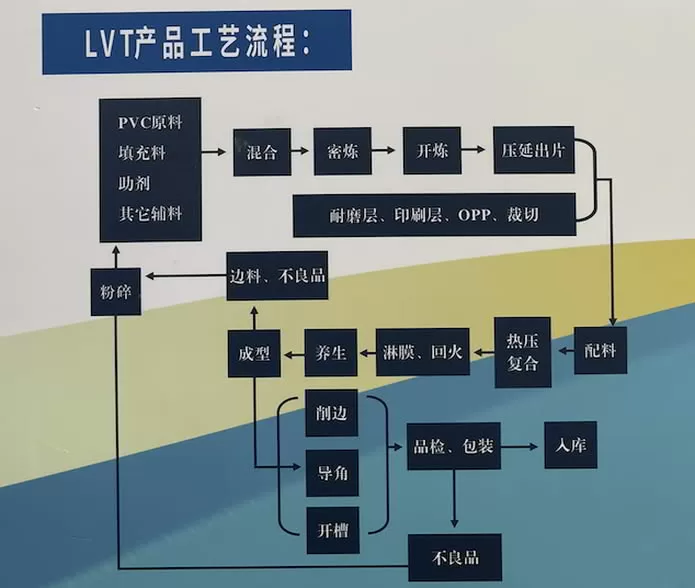
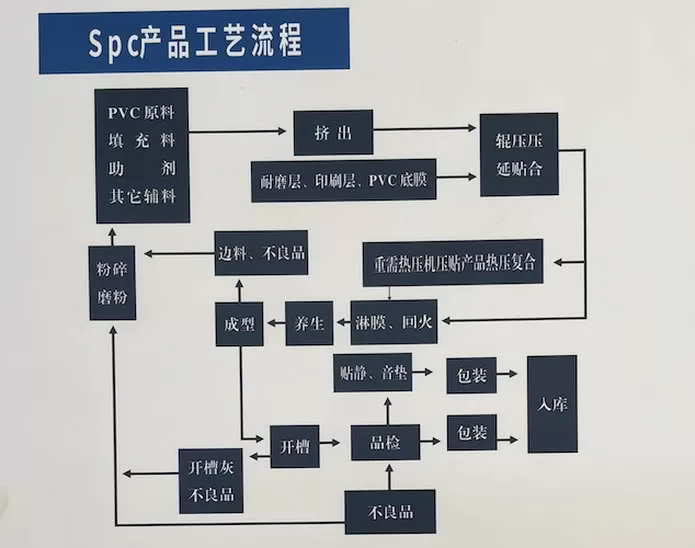
What is LVT flooring?
Luxury vinyl tiles (LVT) fall within the resilient flooring category. The LVT flooring are generally made with PVC based composition and is built in multi-layer structures. Each layer of LVT provides different functionalities that overall provide the complete LVT flooring product. The major benefit of LVT is that it is waterproof, a strong feature that is not offered in wood based hard surface floorings. In addition, with its chemical resistance property, it made clean and maintenance minimal and easy. As an affordable flooring for residential, LVT provides a superior, budget friendly option that other floorings cannot.
Common LVT Product Structure
- UV Protective Coating
- Transparent Wear Layer
- Printed Decoration Layer
- Base Layer
- Reinforcing Fibreglass Layer (Optional)
- Attached Underlay Pad (Optional)
UV Protective Coating
The fundamental function of the UV-protective coating is to prevent color fading for the LVT planks. As LVT flooring is constantly under the exposure of sunlight, the ultraviolet light can cause fading on the printed ink. The UV coating adds a layer of protection against ultraviolet light. With more advanced UV coating solutions, other functions such as anti-bacterial or scratch resistance can also be added.
Transparent Wear Layer
The primary function of the transparent wear layer is to prevent scratch or wear damage to the decoration layer. As LVT flooring will loose its aesthetics when decor film layer is damaged. There are different thicknesses for the wear layer. The most common residential grade is 0.3mm thickness. While for a more premium and commercial grade, 0.55mm thickness is provided.
Below is a chart on the classification of vinyl flooring according to wear resistance performance.
| Classification EN 16511 | Wear Layer Thickness | Wear Resistance ISO 24338 Procedure A |
|---|---|---|
| 32 | 0.2mm | >4000r |
| 33 | 0.3mm | >6000r |
| 34 | 0.55mm | >10000r |
| 34 | 0.7mm | >15000r |
Printed Decoration Layer
The printed decoration layer is the soul to the designing of luxury vinyl floorings. The printing film defines the style and size of the LVT tile. Whether it’s a 5-split or 4-split vinyl flooring design, or whether its 1.2m, 1.5m, or 1.8m length, is all determined by the printing films.
Some premium vinyl flooring collections will also use more sets of printing cylinders so that more unique patterned planks can be made available.
Base Layer
The base layer defines the stability performance of the vinyl floorings. Generally speaking, a thicker base layer will provide improved dimensional stability as well as indenture resistance and impact resistance.
Reinforcing Fibreglass Layer (Optional)
The fibreglass layer is an optional material that is added to improve the dimensional stability performance of the LVT. Therefore, it is often found in dryback LVT as well as loose lay LVT with thicker wear layers. The fiberglass layer provides a more robust strength to keep the planks from curling due to imbalanced expansion and contraction by different layers of material.
Attached Underlay Pad (Optional)
Vinyl flooring with an attached underlay pad will have an improved acoustic performance. Different types of pads are available, including EVA, IXPE, and Cork. Other featured materials, such as PE based and magnetic layers, are also available to specified requirements.
Popular Areas for LVT Flooring Applications
- Residential Homes
- Rental and Multifamily Homes
- Retailer Spaces
- Office and Education
- Other Light Commercial Projects
What is SPC Flooring?
The original SPC (stone polymer composition) was actually applied as wall panels. It is only considered when the market starts to struggle with the toxic flooring scandal in 2015 relating to laminate flooring. At the time, laminate flooring was considered the only hard surface product that had great value in money. While LVT flooring had a similar price range, it was not able to capture the hard surface flooring market due to its flexible attributes. When SPC was launched by leading brands, the market had a rapid shift in favour of SPC flooring. An entirely new type of hard surface flooring that does not use glue and has zero formaldehyde.
Common SPC Product Structure
- UV Protective Coating
- Transparent Wear Layer
- Printed Decorative Layer
- Core Layer
- Attached Underlay Pad (Optional)
Structural Comparison to LVT Flooring
Unlike flexible LVT floorings, rigid core SPC flooring does not need any reinforced fibreglass layer to improve dimensional stability. This is due to the fact that the stone polymer composition is a more rigid material that is more capable of preventing curling. With the successful launch of SPC flooring products into the United States’ market in 2017, SPC flooring has gained rapid market penetration with global success.
Global LVT Flooring Factory
China is perhaps the best marketplace for importing luxury vinyl tiles. With a high concentration of industry clusters that are built around the resilient flooring manufacturing industry, LVT and SPC products from China have significant great value on both quality and pricing. The concentration of relevant industry supply chains also makes it easier to access to different type of designs, accessories, and even innovations.
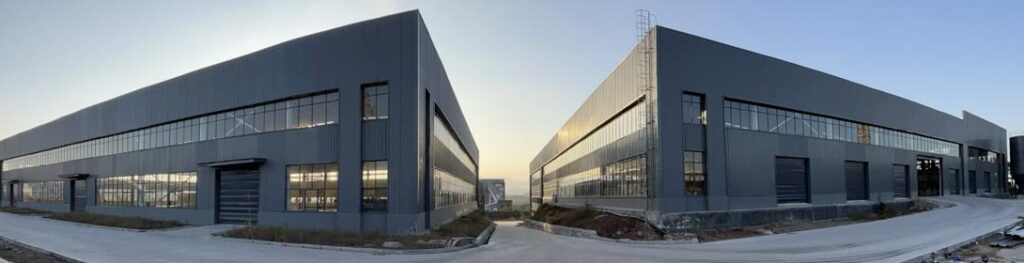
Sichuan Hengdi New Material Group is one of the leading global LVT flooring factories based in central China. With years of experience supporting leading global brands, Hengdi has continued to provide excellence in vinyl flooring export and trades. Our team is made up of some of the most experienced staffs that worked for leading manufacturer brands, and with dedication to developing the next generation of resilient flooring products, we innovate to introduce higher performance vinyl flooring as well as environmentally sustainable flooring products.
Innovation Products by Hengdi
- Magnetic LVT Flooring with Comprehensive Magnetic Underlayment Rolls
- Low Energy Floor Heating System for SPC Floorings
- PVC-Free Resilient (Polypropylene) Floorings
- RTS 1 Rating Laminate-Like Scratch-Resistant Vinyl Floorings
To explore our innovative flooring products, or considering about buying LVT / SPC flooring directly from factories in China, talk to our sales team or submit your inquiries below: